Thanks to all who attended our solar eclipse event!

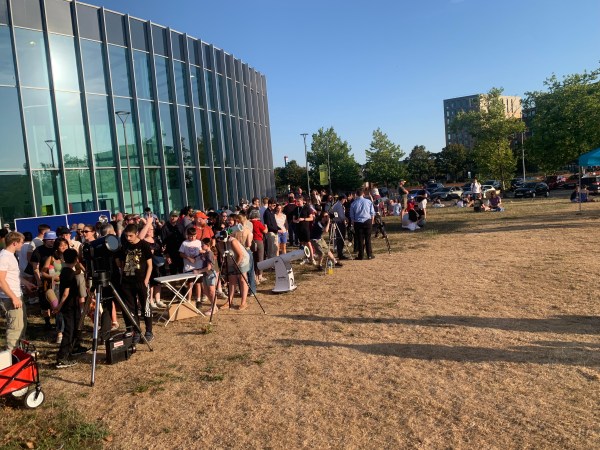
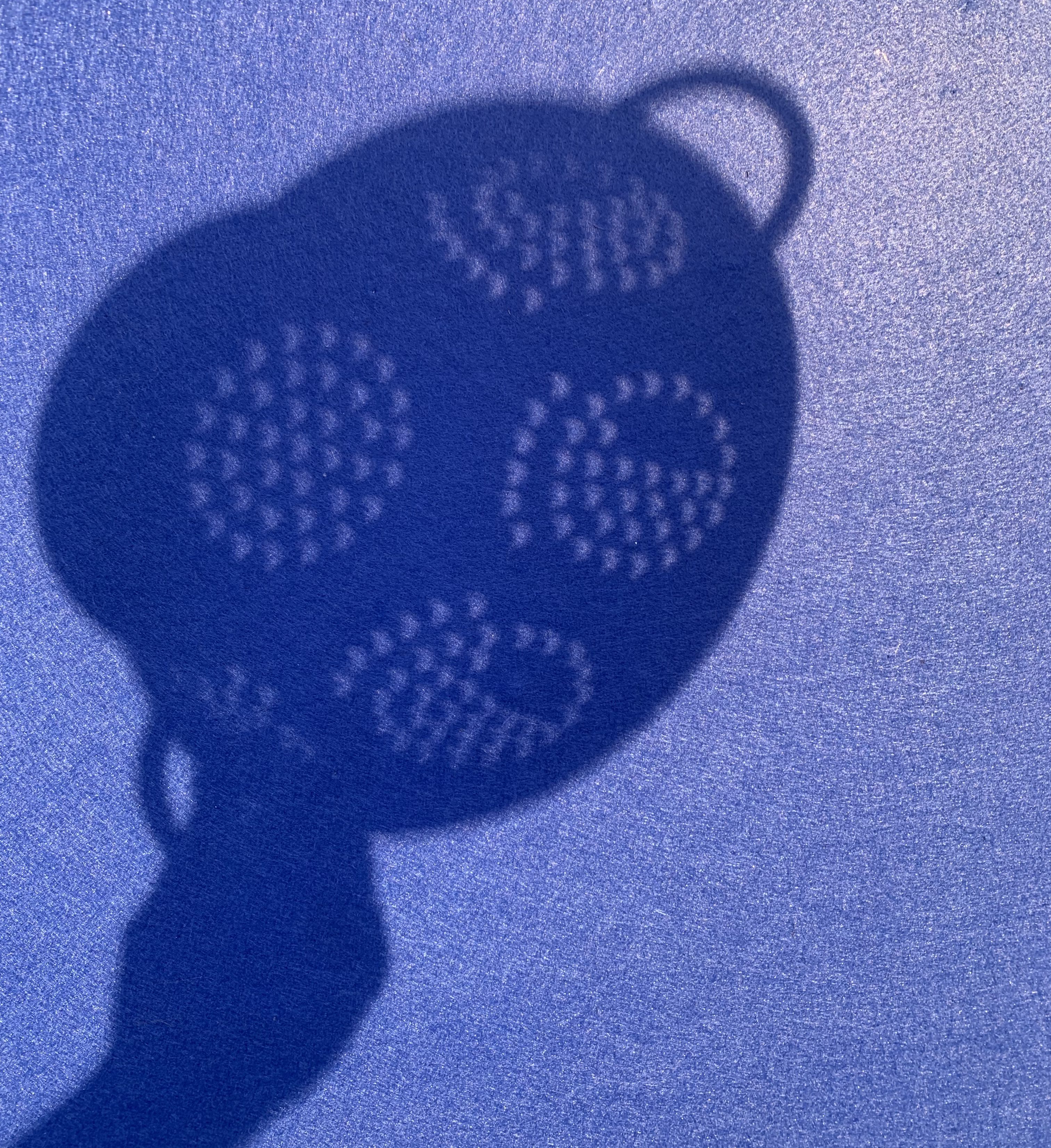
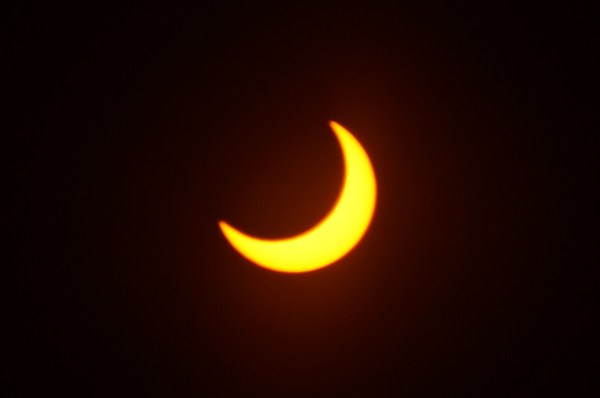
We had a wonderful time last night (12th August 2026) observing the solar eclipse in front of the Isaac Newton Building. Thanks to all 150-200 people who attended! The skies stayed clear so we managed to view almost the entirety of the eclipse from 6:14 to just before 8pm (the eclipse ended at 8:03pm). Attendees who borrowed our solar eclipse glasses and looked through our array of telescopes were treated to a crescent Sun produced by 90.5% coverage by the Moon at around 7:10pm. At this time it became noticeably darker and more comfortable to stand in the Sun (due to less heat from radiation). We also had lots of fun with colanders making patterns through their holes. If you’ve caught the eclipse bug there will be a smaller partial eclipse to view next year from Lincoln on 2nd August (36% obscuration). The next big partial solar eclipse (62% obscuration) from Lincoln will be on 21 August 2036. We hope to see you there!
Near-total solar eclipse viewing event on 12th August (6-8pm)

Weather permitting, we will be holding a eclipse-viewing event on the grass outside of the Isaac Newton Building on 12th August to observe the near-total eclipse of the Sun occurring roughly between 6 and 8pm. Everyone welcome! Maximum eclipse (90.5% obscuration, that is area of the Sun covered) should occur in Lincoln just after 7:10pm BST. The next time we will see such a high percentage of obscuration from Lincoln will be in 2090, and that will be incredibly close to the horizon at its maximum eclipse. The closest before that will be in 2065 with over 80% obscuration, so this really is a special event!

We are organising this event in collaboration with Prof Edward Hanna’s group at the School of Natural Sciences, whose work includes studying the effect of solar eclipses on the weather. We will have several telescopes fitted with solar filters for safe viewing and solar-eclipse glasses to borrow.

Of course, we shouldn’t need to remind you to never look directly at the Sun or through a telescope or binoculars without a proper solar filter fitted at the input aperture (not the eyepiece!). For more information on how to view the eclipse safely, see here. For visualisations of the eclipse shadow as it moves across the Earth, see here. You can also watch the eclipse live streamed from Greenwich observatory on 12th August here. Dr Sutton has also posted a video on his channel about the eclipse here.

Family Physics singalong at Have A LAFFF! 2026

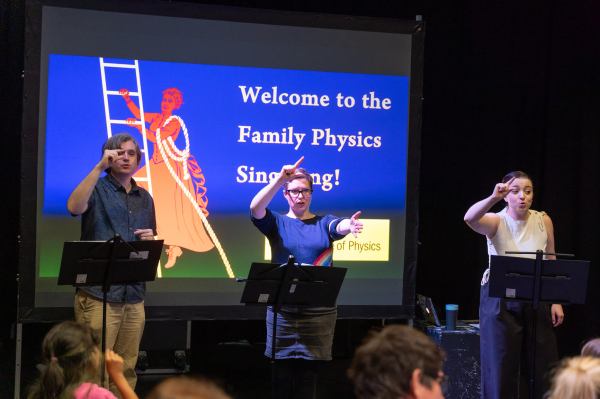
At the end of July, Dr Johnston was part of a Physics Sing-along at the Lincoln Arts Centre’s Have A LAFFF! 2026, where she talked about her job as an astronomer, her observations of molecules in regions of space where stars are being born and helped families write their own songs about space! The workshop was led by LAC Innovate Artists Helen Arney, Brian Mackenwells and Jenni Pinnock, who have also been working with Performing Arts students at Lincoln to stage their new musical “The Cambridge First All-Ladies Fire Brigade”. We also talked about a physicist who should be famous, Hertha Ayrton, who is one of the real-life trail-blazing women physicists from the musical. The musical tells the story of Hertha, who along with others (including an astronomer and solar-expert, Annie Maunder!) started a fire brigade at their college to ensure that it would be protected, as the nearest fire station was too far away.

The all-women’s fire brigade at Girton College, Cambridge

Tiny crystals in Earth’s crust have captured the movement of the Milky Way’s spiral arms

Milky Way above a rocky coastline

Dr Phil Sutton has collaborated with Prof Chris Kirkland, a geologist at the University of Curtin, Australia, to determine that the Solar System passing through the spiral arms of the Milky Way can be linked to changes seen in crystals in the Earth’s crust. Their research used measurements of zircon oxygen isotopes, which record the amount of melting in the Earth’s crust and how much the crust interacted with water from the Earth’s surface. This supports the theory that when the Solar System passed through the spiral arms of the Milky Way, it pushed more bodies like comets and asteroids towards Earth, increasing the number of impacts on Earth at these times and melting the Earth’s crust. Therefore, the evolution of Earth was likely influenced by our Galaxy at large! They have published their work in Physical Review Research and written about their discovery in The Conversation. It has also been reported in Forbes.

Next Astro-Chat on 29th May 2025

The next Astro-Chat hosted by Professor Andrei Zvelindovsky at the University of Lincoln, with distinguished guest Professor Don Kurtz, will be held on 29th May 2025 at 7-8pm GMT, in which Don will discuss optical telescopes, including how they work and some of the most spectacular discoveries they have made. After the talk by Don, members of the public will be able to ask questions in the live-chat.

Book a place here: https://science-views.org/2025/05/25/xmas-astro-chat-big-glass-the-giant-telescopes/

You can also catch up with previous Astro-Chats using the YouTube Playlist above!

Start a Blog at WordPress.com.

Up ↑