The Sub-Neptune Radius Valley: A Preview of Our New Module “The Solar System and Exoplanets”

Excited for the second year of our new Physics with Astrophysics degree program at the University of Lincoln! Right now, I’m fully immersed, working on one of our new modules called “The Solar System and Exoplanets.” We’re diving deep into how planets form and trying to unravel the mystery of the huge variety of exoplanets we keep discovering. Check out this quick video for a taste of what we’re digging into in the module.


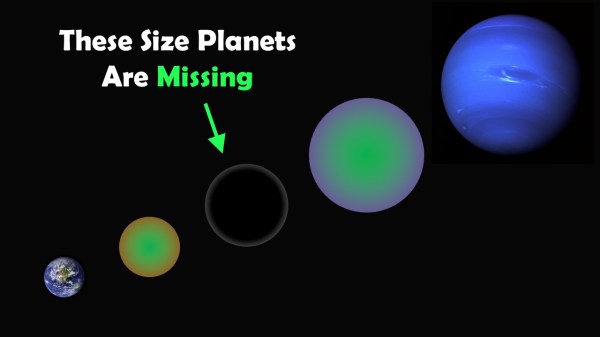
The apparent lack of planets with radii 1.5–2 times that of Earth is known as the Sub-Neptune radius valley. First noted in 2011, a bimodality in the Kepler exoplanet population was ascribed to the lack of substantial gas atmospheres on close-in, low-mass planets. It was mentioned that this trait could support the growing theory that atmospheric mass loss could be caused by photoevaporation. This would result in a population of planets with thick envelopes dominated by helium and hydrogen with bigger radii at higher separations from their parent stars, and a population of naked, rocky cores with lower radii at small separations.

Lecturer in Astrophysics

The School of Mathematis adn Physics at the University of Lincoln has a New post open for Lecturer in Astrophysics. For full details see the following job advert:

https://jobs.lincoln.ac.uk/Vacancy.aspx?ref=COS983

The University of Lincoln opened the School of Mathematics and Physics in September 2014 as part of the College of Science. The school provides undergraduate and postgraduate education and conducts research in pure and applied mathematics, physics and astrophysics. The school is expanding its provision and is opening a new undergraduate Physics with Astrophysics degree from September 2023.

We are now seeking suitably qualified applicants for the post of Lecturer in Astrophysics to join our Astrophysics team.

The post holder will be expected to develop their own research and we are considering applicants with research interests in any aspect of astrophysics. Our successful candidate will be passionate about teaching and outreach, and will be prepared to deliver teaching in a range of modules offered by the school, including the Astrophysics modules of the new degree. The post holder will join a friendly community at the School of Mathematics and Physics and be part of our rising University, located at the heart of the historic city of Lincoln.

We are especially encouraging applications from groups underrepresented in STEM. Candidates with a career break are also encouraged to apply.

The University of Lincoln offers exciting career opportunities with the chance to grow and develop to reach your full potential. We also offer a wide range of staff benefits, including a generous annual leave allowance, progressive pay rates, access to discounts at popular stores and more. If you will need to relocate to Lincoln from within the UK or internationally for this opportunity, we understand how difficult this can be. We have dedicated support in place to make the process as simple for you as possible. 

Work experience week 2022

Matthew Booth's avatarStudy Physics in Lincoln

Last week the School of Mathematics and Physics hosted 5 work experience students from Lincoln University Technical College, Branston Community Academy and William Farr.

The aim of the week was to give a taste of what it would be like to study Mathematics or Physics at the University of Lincoln (or elsewhere), and for the students to gain some experience related to working in a university.

On Monday the students were given a tour of the University of Lincoln campus and the Isaac Newton Building in which the School of Mathematics and Physics is based. We also gave the students a very useful talk about the university application process and finances.

“We received some insightful information about how to make your
application stand out from other applications, how to know how much money you
will receive from loans and how to use student loans when living independently.”

On Monday afternoon…

View original post 488 more words

Physics Film Night after the pandemic – 30/3/2022

Andrei Zvelindovsky's avatarIOP Lincoln Centre

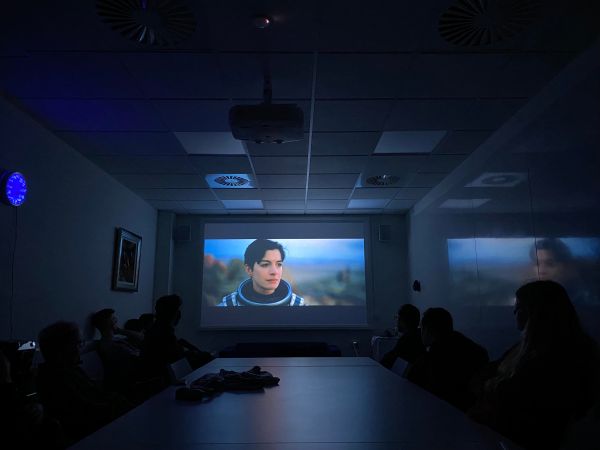
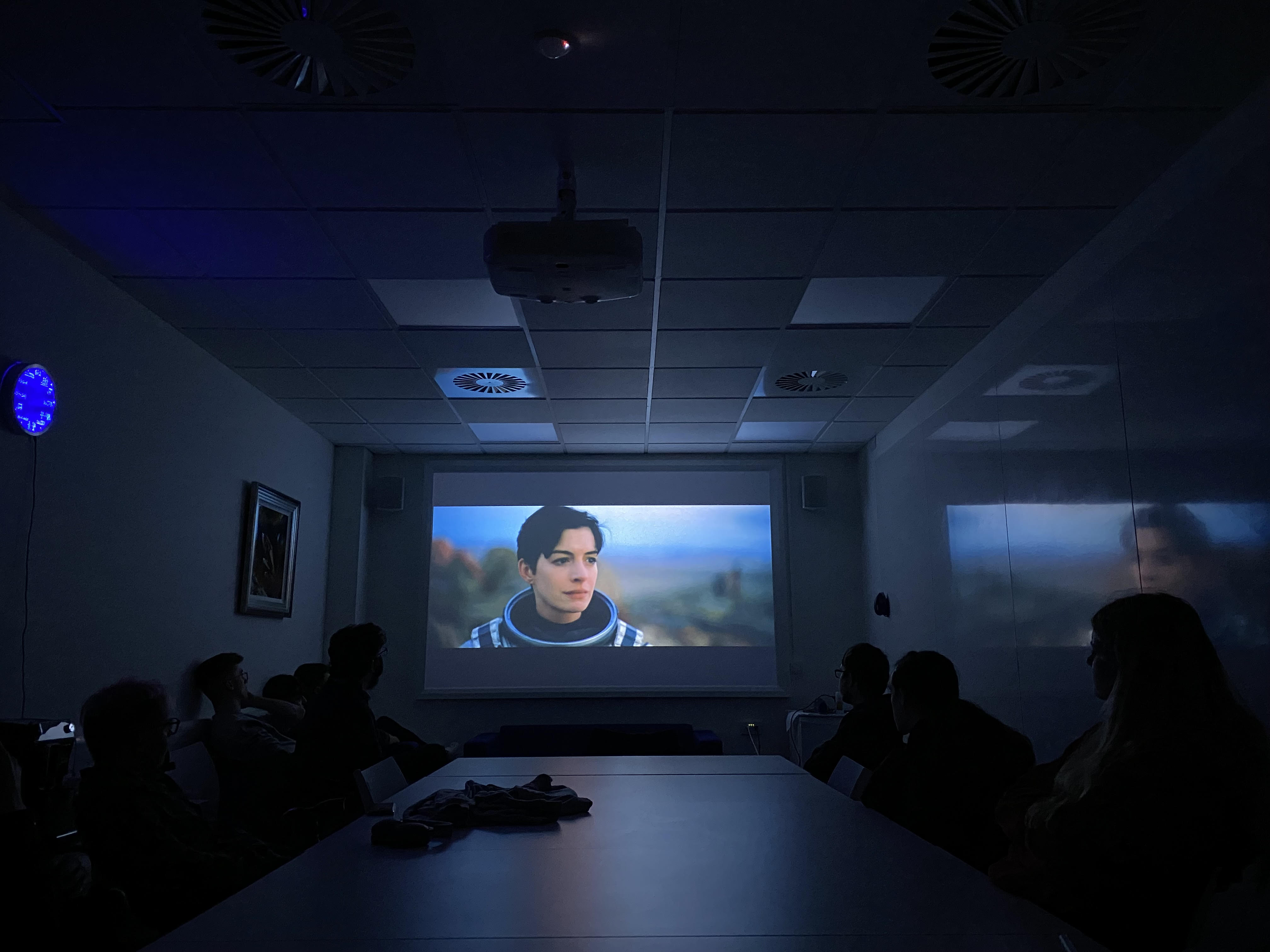
On 30 March 2022 Lincoln School of Maths & Physics and the University of Lincoln Maths and Physics Society hosted the  Physics Movie Night, the first such event after the pandemic. It took place for most of its time in the Stephen Langton Building Lecture Theatre and finished for the last 10 minutes in our own INB3305 room in the Isaac Newton Building. The movie screened was Interstellar, which was the subject of discussion in our 3rd year Physics module “Physics of the Universe”. The night started at 6:30pm with a discussion and pizzas.

View original post

Physics Film Night – 18/5/2022

Andrei Zvelindovsky's avatarIOP Lincoln Centre

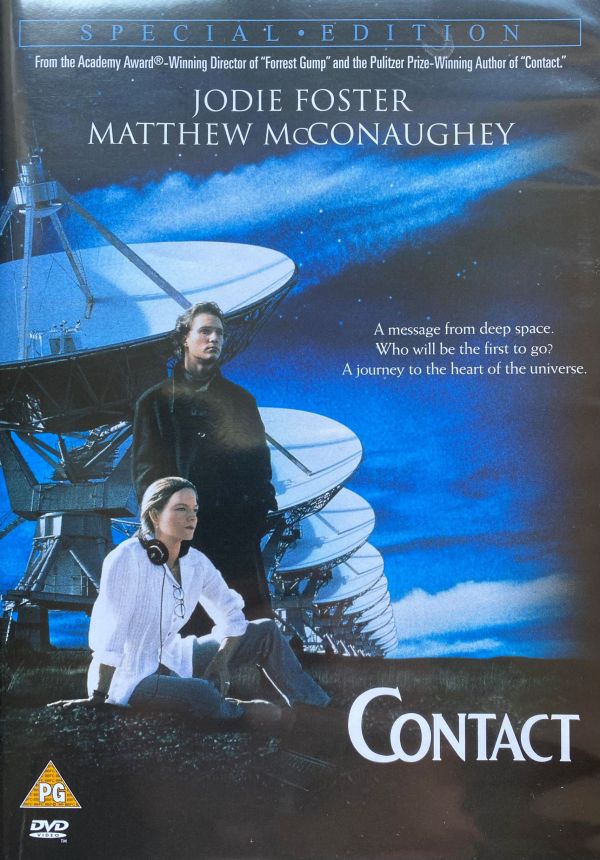
Lincoln School of Maths & Physics and the University of Lincoln Maths and Physics Society are happy to invite you to the Physics Movie Night, the second one after the pandemic.

Date: Wednesday, 18 May 2022
Film: Contact (1997)
Stars: Jodie Foster, Matthew McConaughey
IMDB: 7.5/10; Awards: 15 wins & 27 nominations
Genre: Drama, Mystery, Sci-Fi
Details: 2h 30min, PG
Where: The Swan, Lincoln 
Time:  Doors open 19:30

A fascinating film about the search for extraterrestrial intelligence (SETI).

The night will start with a discussion and pizzas.

You are welcome to read  a short introduction to the Lincoln Astronomical Society given by Dave Castledine almost 6 years ago at the previous screening of this film.

Spaces are limited and the access is by the reservation through University of Lincoln Maths and Physics Society .

View original post

Winners of UROS-2021 research projects awards

Evgeny Khukhro's avatarMaths & Physics News

In the university-wide Undergraduate Research Opportunities Scheme (UROS), the in 2021 are students of School of Mathematics and Physics:

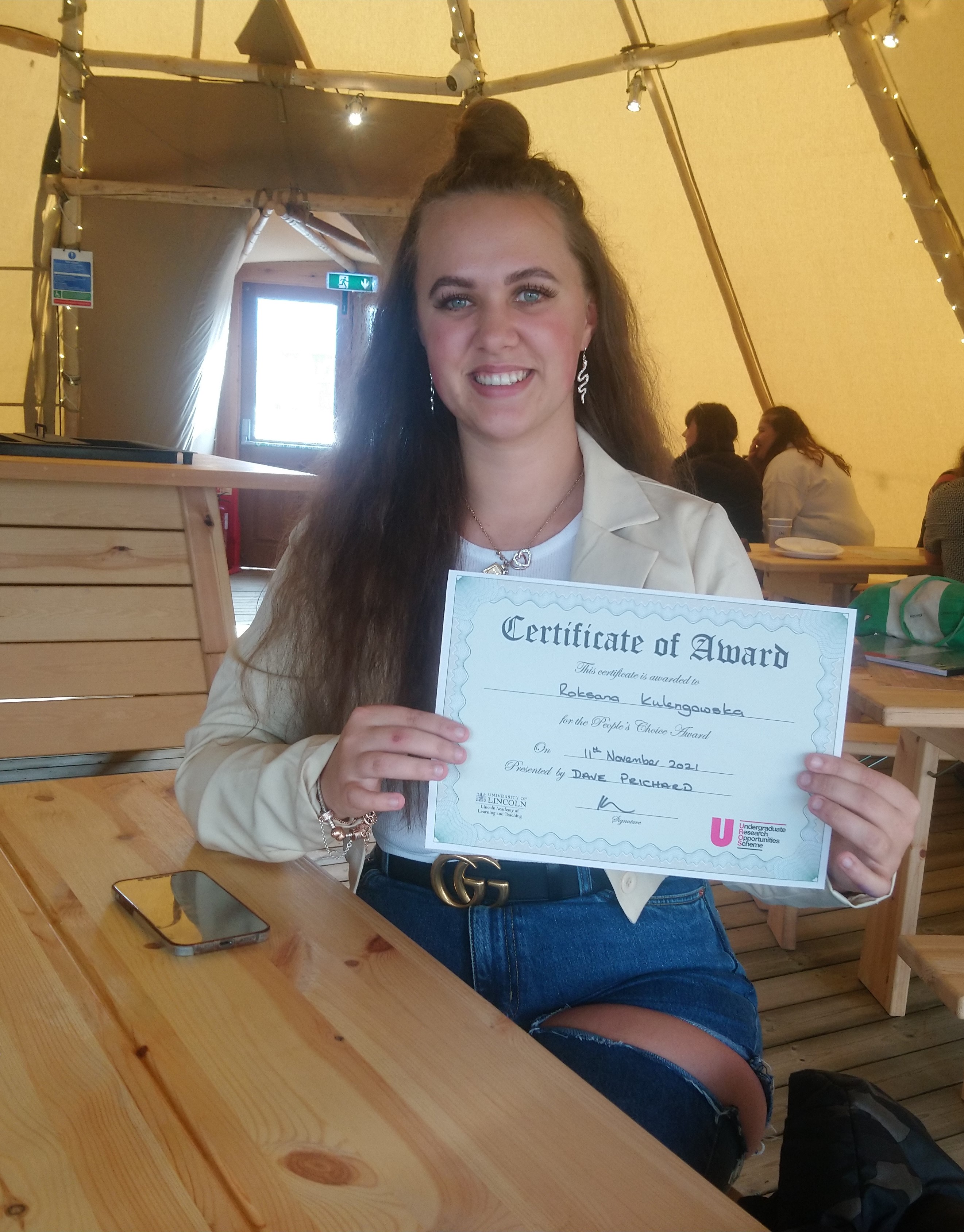
Roksana Kulengowska, with project “Calculating the Hill Sphere of Known Exoplanets: Which Exoplanets Could Host Moon Systems?“, under supervision of Dr Phil Sutton, and

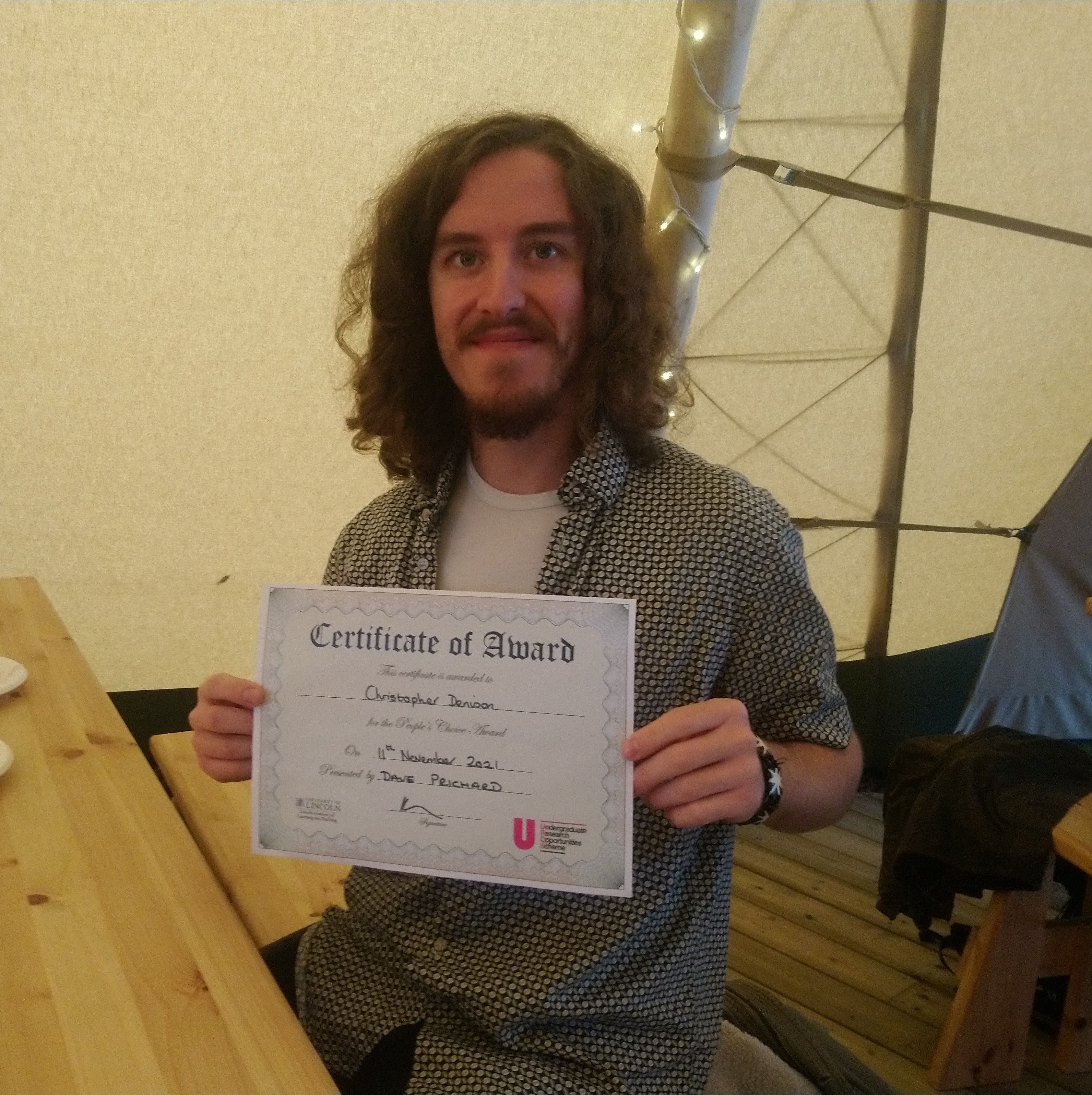
Christopher Denison, with project “Lamellar Block Copolymers Under Shear Flow“, under supervision of Dr Marco Pinna & Dr Javier Diaz.

These wins continue the successful participation of our students in previous years: in 2020 one of the two runners-up for People’s Choice Award was

Henry Macpherson, with project “Mathematical modelling of polymer capsules“, under supervision of Dr Martin Greenall (https://staffnews.lincoln.ac.uk/2020/11/30/uros-award-winners/)

The 2021 winners were announced at the on-campus UROS Celebration event on the 11th November, in Skal Tipi:

View original post

Start a Blog at WordPress.com.

Up ↑