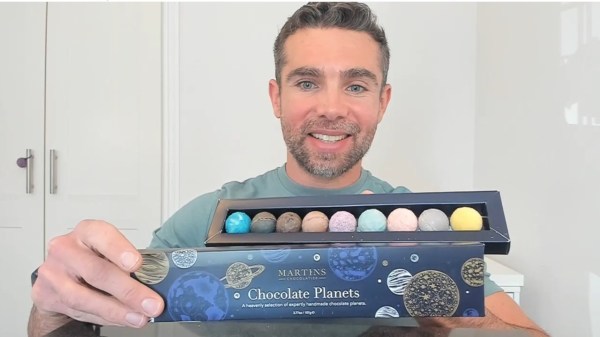
Join Dr. Phil Sutton, planetary scientist and Senior Lecturer in Astrophysics, on a unique journey where space meets flavour in two deliciously creative science videos. Ever wondered what the solar system might taste like? In this post, I blend astrophysics with artisanal chocolate to explore planets and moons through both science and flavour. With two videos, we’ll compare handcrafted chocolates to celestial bodies — from fiery planets to icy moons — using taste, texture, and a whole lot of planetary insight.
Planet-Themed Chocolates vs. the Real Solar System
I discovered a stunning set of chocolates modeled after the planets — from Mercury to Neptune (and yes, even the Sun!). In this tasty experiment, I compare each chocolate planet to its real celestial counterpart. How accurate are the colors & textures? Which ones pass the space test, and which are just sweet imposters?
👉 Check out the chocolates
Moons and Bonbons – A Cosmic Chocolate Pairing
In this second video, I take things deeper — literally — by pairing nine artisanal chocolates with nine of the solar system’s most fascinating moons. Each chocolate represents the unique characteristics of moons like Europa, Titan, and Enceladus, using flavour and texture to mirror their geology, heat, and icy shells.
👉 See the bonbons
From the swirling storms of Jupiter to the icy geysers of Enceladus, space is full of surprises — and so is chocolate. I hope these videos gave you a new way to experience the solar system, one bite at a time. Let me know your favourite flavour–moon combo, and stay tuned for more science you can taste!

 Lincoln Astrophysics Team